04 Alloy Process 03
Why Holes, Not Thickness
A film of cooler air over the surface does more than more metal would.
A cooler skin does what extra metal cannot
The hottest part of a modern gas turbine runs at temperatures that would melt the blade itself — not by a small margin, but by several hundred degrees. The nickel superalloy in a first-stage turbine blade has a melting point around 1,300 °C; the gas flowing past it in a Rolls-Royce Trent engine routinely exceeds 1,700 °C. The blade survives not because it is thick enough to resist that heat but because it is never truly exposed to it.
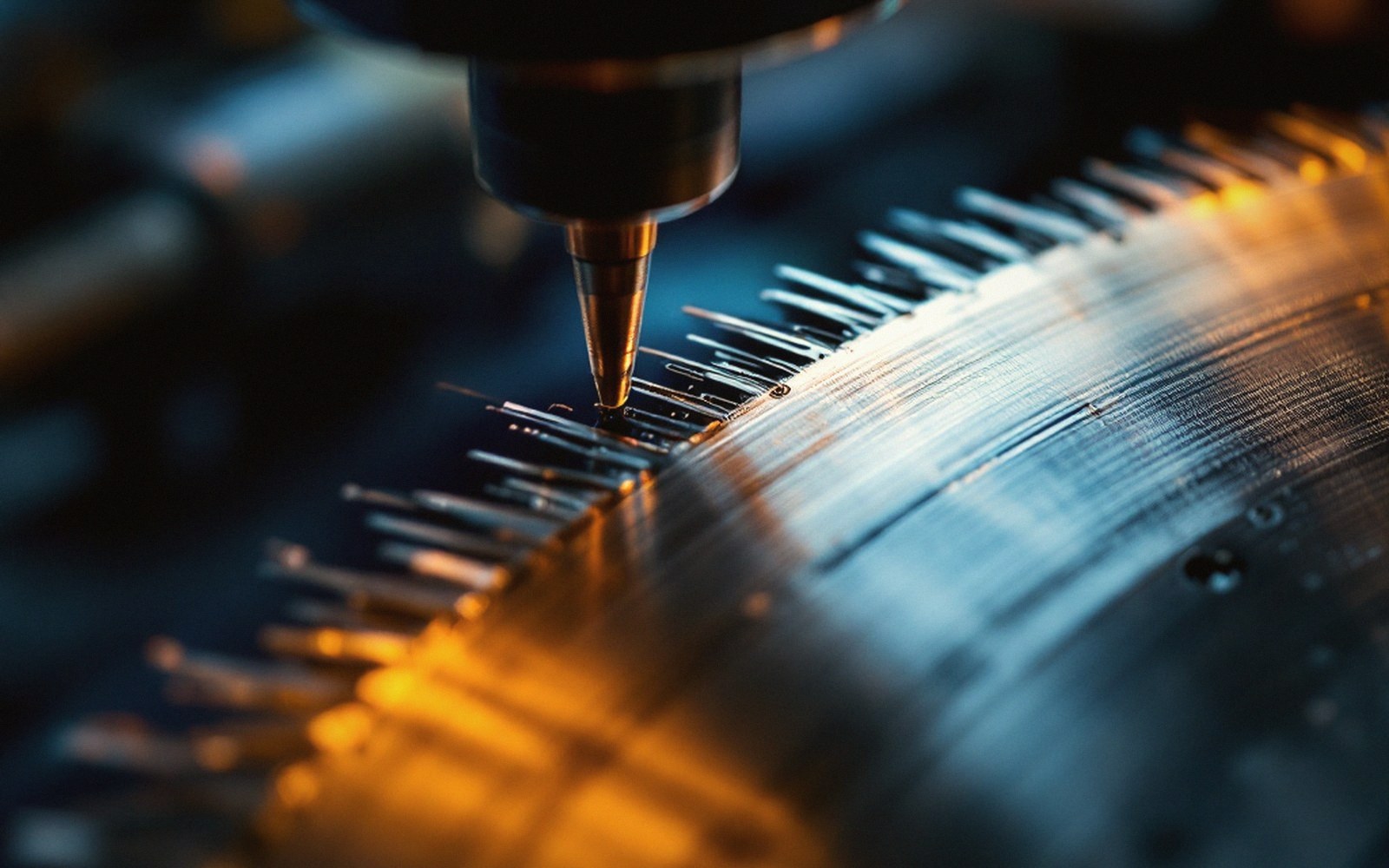
The technique is called film cooling, and it works by bleeding compressed air from the engine's own compressor stage, routing it through a network of internal passages cast into the blade, and exhausting it through rows of tiny holes — each roughly half a millimetre across — drilled through the blade wall. That air exits as a thin, continuous film that clings to the external surface, interposing a cooler boundary layer between the hot gas and the metal. The blade is, in effect, wearing a jacket of moving air.
Drilling those holes is not straightforward. The passages inside the blade are formed during investment casting, when ceramic cores are placed inside the wax pattern and later dissolved out with caustic solution, leaving hollow channels where solid metal would otherwise be. The exit holes themselves — several hundred per blade — are cut after casting by electro-discharge machining ↗ or laser drilling, both of which can work to the tolerances the geometry demands without introducing the cracking risk that mechanical drilling would carry into a single-crystal component.
Why not simply use more metal? Adding wall thickness increases thermal mass but also increases the temperature gradient through the section, which introduces the cyclic stress that cracks blades from the inside. More metal is heavier, and weight in a rotating component multiplies into enormous centrifugal load. A thicker blade also responds more slowly to temperature changes at start-up and shutdown — exactly when thermal fatigue is at its worst. The holes, by contrast, add no structural weight of consequence and address the problem directly: if the surface never reaches the gas temperature, the bulk of the blade is protected without needing to be redesigned.
How it works — in sequence
04 Alloy · lifted out of the flow- 01Compressor air is bled off and routed internally through cast passages
- 02Air exits through laser-drilled holes, ~0.5 mm diameter, in rows across the blade surface
- 03The exiting air forms a film that keeps surface temperature below the alloy's melting point
- 04A ceramic thermal-barrier coating (yttria-stabilised zirconia) adds further insulation on top
Rolls-Royce's manufacturing facility in Derby produces blades of this type, where the casting, core dissolution, thermal-barrier coating application and laser drilling each happen in sequence under strict process control. The coating — a ceramic layer typically of yttria-stabilised zirconia — adds another 100–200 °C of temperature capability on top of what the film provides. Together, a hollow alloy blade, a ceramic skin and a moving curtain of air achieve what no thickness of solid metal could.