02 Clay Process 02
Throwing and Jiggering
Hand-thrown against machine-formed on a profile tool, and where each is still used.
The Wheel and the Profile
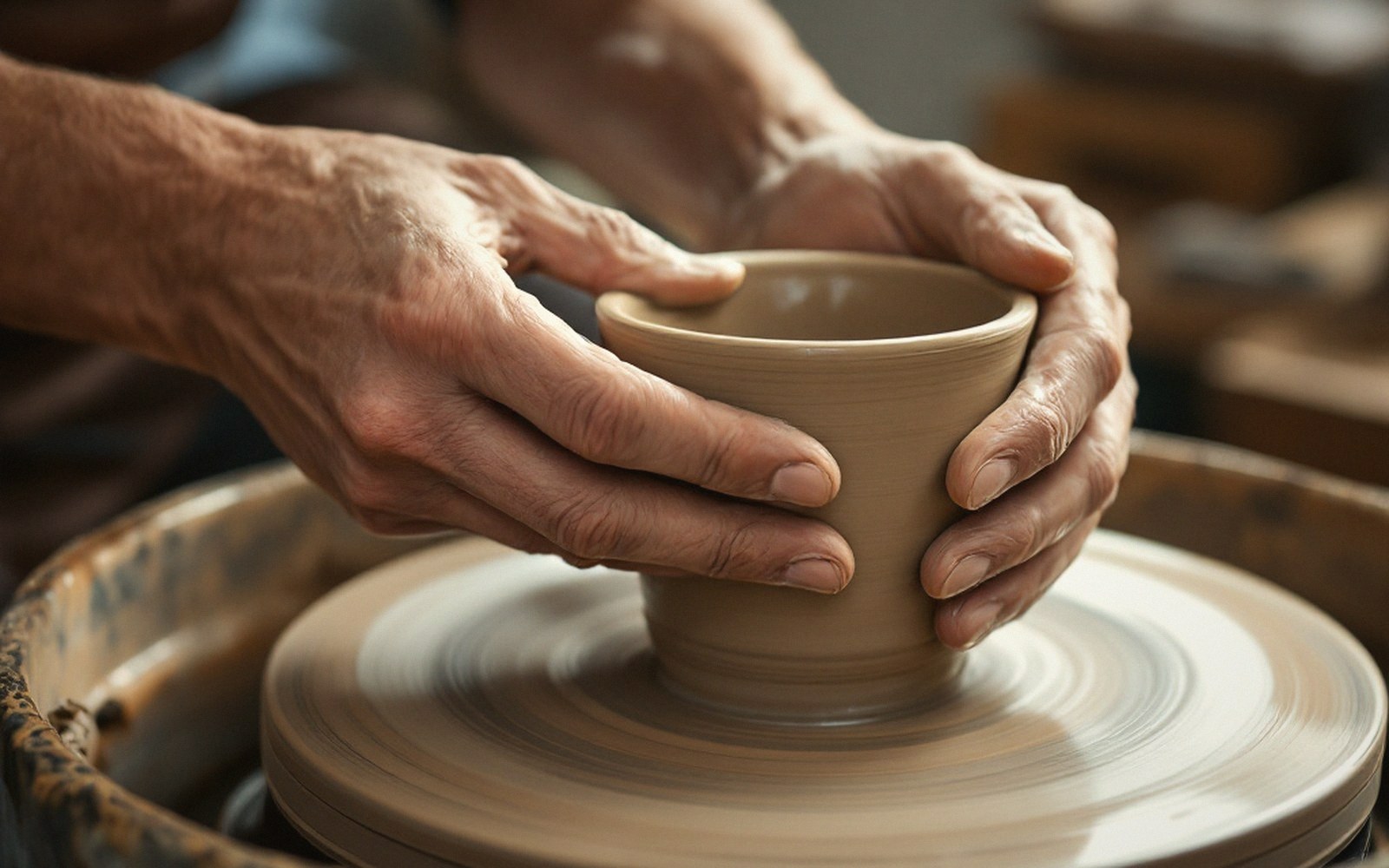
A thrower centres a ball of clay on a kick-wheel or electric wheel, opens it with the thumbs, and draws the walls upward with wet hands — a sequence that has not fundamentally changed since the Bronze Age. The skill is in the pressure: too much collapses the wall, too little leaves it uneven. What comes off the wheel is never quite the same twice, which is, depending on the object and the market, either the whole point or a problem to be solved.
Jiggering solves it. A lump of clay is dropped onto a revolving plaster mould that forms the inside (upper face) of a flatware piece — a plate, a saucer — while a profiled metal or composite blade, the jigger arm, descends to shape the back. For a cup or a bowl, where the outside is the mould, the process is called jolleying, but the principle is identical: one surface defined by the mould, the opposite surface defined by the profile tool. The mould absorbs moisture from the clay and the piece releases cleanly once it stiffens. A trained operative on a jigger can produce far more pieces per hour than a thrower, and each will match the last.
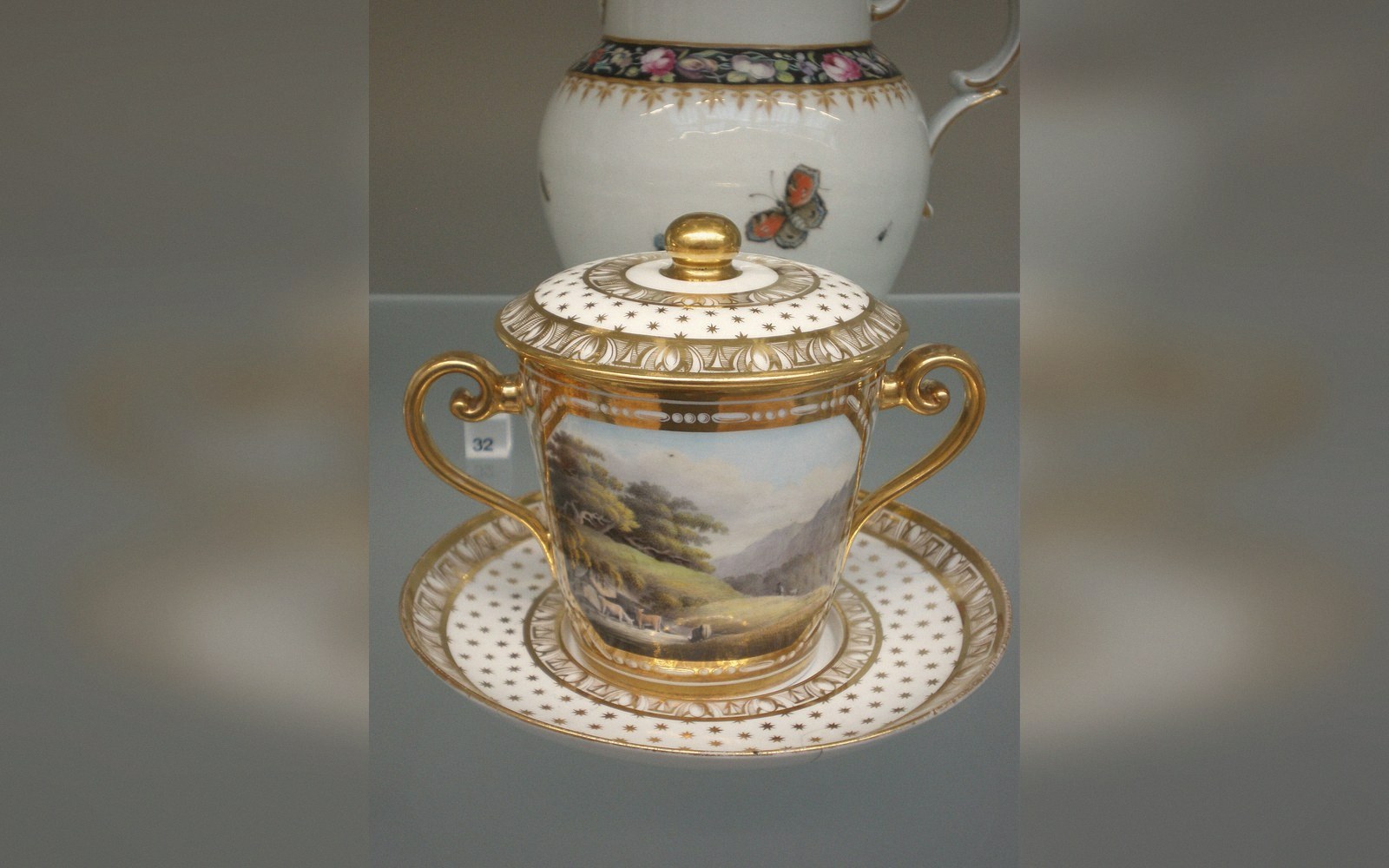
The Staffordshire potteries developed jiggering through the eighteenth and nineteenth centuries as tableware demand scaled up, and Stoke-on-Trent remains the centre of British industrial ceramics. Wedgwood ↗, founded by Josiah Wedgwood at Burslem in 1759, was among the firms that drove the rationalisation of forming methods — not to eliminate craft, but because consistency was itself a commercial requirement when selling dinner services by the dozen to households who expected every piece to match. Modern automated jigger machines at the larger Stoke factories run with minimal manual intervention, the jigger arm controlled by a cam or a CNC profile, and output is measured in thousands per shift.
How it works — two methods compared
02 Clay · lifted out of the flow| Throwing | clay opened and raised by hand on a rotating wheel; every piece unique |
| Jiggering | clay pressed between a rotating plaster mould and a fixed profile blade; open flatware forms |
| Jolleying | same principle as jiggering but for hollow ware (cups, bowls); mould forms the outside |
Where Each Still Lives
Hand-throwing survives wherever the object is too sculptural, too varied in form, or made in too small a run to justify tooling. A studio potter working alone on a wheel in a small workshop produces a fundamentally different thing from an industrial jigger: the walls carry the memory of the hands, the thickness varies slightly, the foot is cut rather than moulded. That variation is legible, and it is what buyers of studio ware are paying for.
There is also a category between the two. Some smaller potteries use a jigger for the initial rough form and finish by hand — trimming, turning on a wheel to refine the foot, adding handles pulled from a fresh coil rather than cast. The glost firing makes no distinction between a thrown and a jiggered body underneath the glaze, but an experienced eye can read the surface of the clay before it goes in.
The wheel makes a cylinder; the profile tool makes the same shape twice. Both are still in use, and the work decides which.
Jiggering cannot do everything. Hollow forms that are closed at the top — teapots, vases with narrow necks — cannot be formed over a single mould and are either thrown, slip-cast, or assembled from jiggered sections joined with slip. The jigger is a specialist tool: fast, accurate, and entirely committed to open, rotationally symmetrical forms. The wheel is slower, demands more skill, and produces almost anything round.
The practical outcome in British ceramics is a clear division: industrial tableware in Stoke-on-Trent is jiggered and jolleyed at scale; studio and artisan ware is thrown; and a band of smaller manufacturers use both, choosing by the form. Neither method is superior in the abstract — each is the right answer to a different question about what the clay needs to become.