05 Leather Process 01
The Goodyear Welt
A strip stitched to the upper and insole lets the sole be replaced, which is an argument about time rather than fashion.
What the welt does
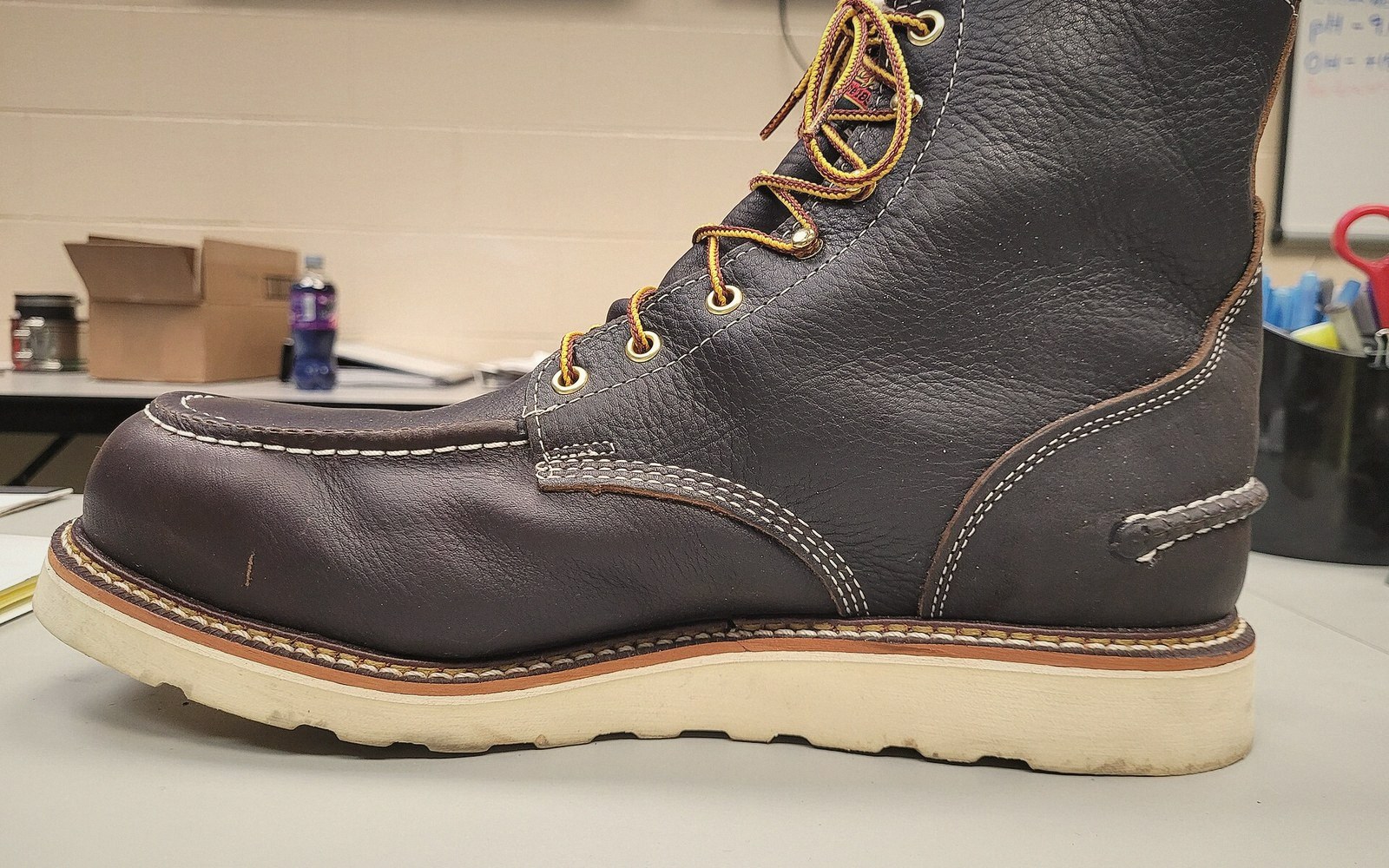
A Goodyear-welted shoe is built around a strip of leather — the welt — that runs the perimeter of the shoe and is stitched to two things at once: the upper drawn over the last, and a strip of fabric or leather called the insole rib. That double stitch is the structural idea. The outer sole is then stitched to the welt's lower face, which means the sole can be cut away and replaced without touching the upper at all. One seam holds the shape of the shoe; a second holds the walking surface. Separate them, and a shoe made in Northampton in the 1980s can be resoled in 2025 and handed on again.
The welt itself is a narrow, flat strip, typically eight to nine millimetres wide, skived thin at both edges so it lies flush. In a factory using the Goodyear process — named for Charles Goodyear Jr., who mechanised it in the United States in 1871 — the inseam is sewn by a curved-needle machine that reaches inside the shoe cavity and pulls the thread through the welt and rib in a single operation. Before that machine existed, the same structure was made entirely by hand, the craft now called handwelting, and the operation remains essentially identical in its geometry even when a machine replicates it.
Northampton, the last, and the rib
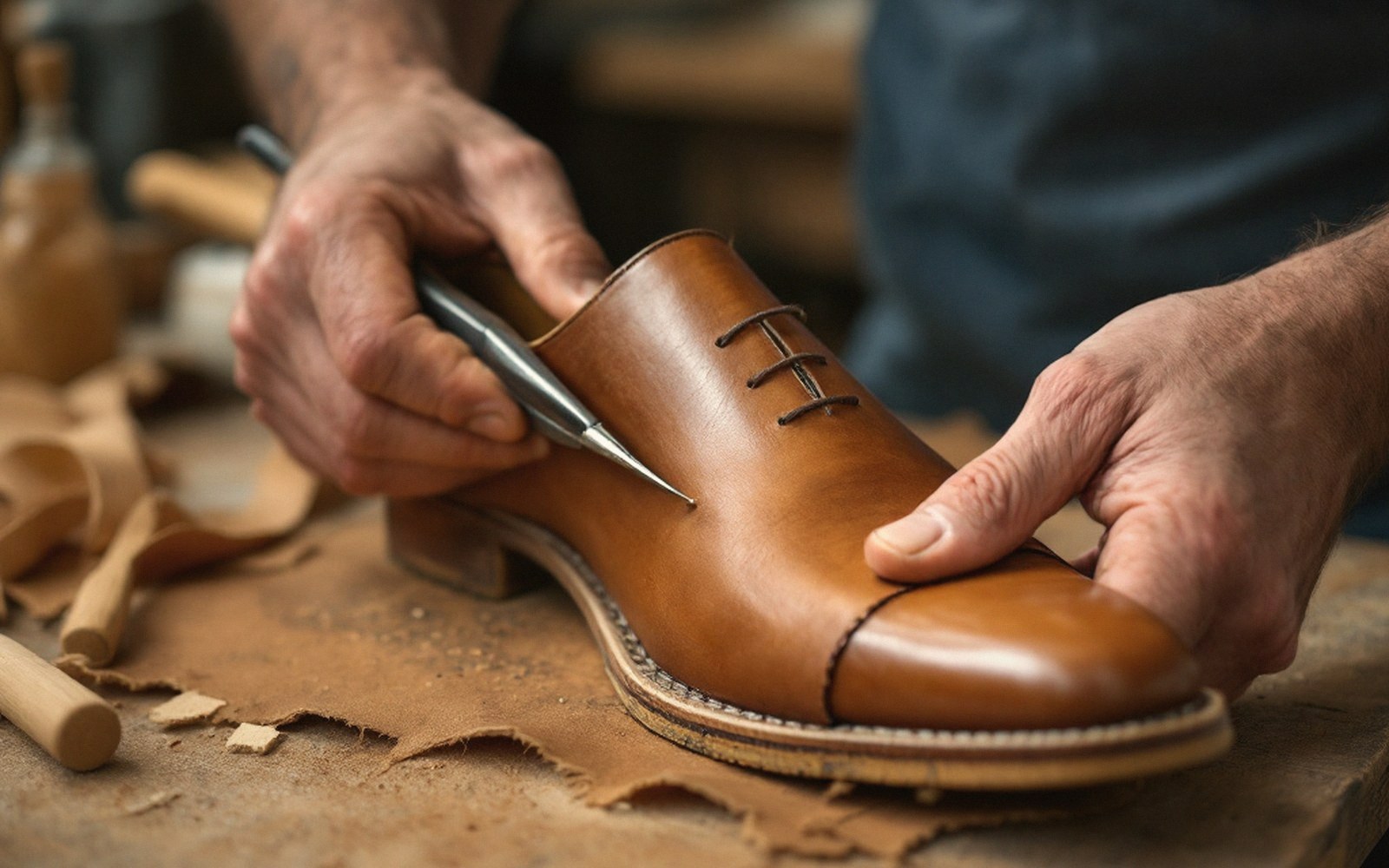
Northampton is the centre of English welted footwear, a concentration that dates to the Civil War period and deepened through the nineteenth century as the town mechanised faster than its rivals. Makers such as Cheaney, Crockett & Jones and Edward Green still work there, each maintaining the sequence that the Goodyear system organises but does not simplify. Lasting — pulling the upper tight over the wooden last and tacking it firm — comes before the welt can be attached, because the upper must hold the shape of the last perfectly while the inseam is sewn. The last is the mould; the welt is the lock that fixes the result.
The insole rib is what the welt stitches to on the inside. In a traditional construction this rib is either cut directly from the insole leather — a technique called a feather — or gemmed on, bonded as a separate strip of stiff fabric. The cavity created between welt and insole, inside the shoe, is filled with a cork and adhesive compound that compresses over time to the wearer's foot. This is the reason an old welted shoe fits differently from a new one: the fill has conformed, and the shoe carries a record of the foot that wore it.
How it is built
05 Leather · lifted out of the flow| Welt | the perimeter strip of leather, stitched to both upper and outer sole; the structural idea in one word |
| Insole rib | the ledge the welt stitches to on the inside, either cut from the insole (feather) or bonded on (gemmed) |
| Inseam | the inner stitch joining welt and rib, sewn by a curved-needle machine or by hand |
| Last | the wooden form over which the upper is pulled and held while the welt is attached |
| Cork fill | the compound packed into the cavity between welt and insole, which conforms to the wearer's foot |
| Sole channel | the cut groove in the outer sole that houses and protects the lockstitch |
The outer sole — in a quality shoe, a single piece of vegetable-tanned leather from the bend of a hide, dense and slow to cut — is stitched to the welt with a lockstitch, typically nine to eleven stitches per inch, by a machine called a sole-stitcher. The channel the stitch sits in is cut into the leather, the thread is laid in, and the channel lip is glued back over it to protect the stitching from abrasion. This is the only part of the construction the ground ever touches.
The seam between upper and sole that makes a shoe worth keeping
An argument about time
The case for the Goodyear welt is not primarily aesthetic. It is that a well-made upper — lasted properly, with good leather and sound stitching — will outlast several soles if the construction allows the soles to be changed. A cemented shoe, where upper and sole are bonded with adhesive, offers no such separation; when the sole fails, the shoe fails. The welt delays that equation. A cobbler with the right curved needle and a supply of matching welt can restore the sole of a welted shoe in under an hour, and the upper is undisturbed.
The materials determine how many times this can happen. A hide-leather insole stiffened with steel and time will go further than a resin board; a sole leather from a tannery that takes its time will compress more slowly than one rushed through. The construction is a promise, but it is only redeemed by what goes into it. That is the decision made in Northampton, or wherever the pattern is cut — not at the moment of resoling, but at the beginning.