03 Steel Process 01
Sheffield edge
Crucible steel gave a fine, even grain that took an edge, and the reputation outlived the process.
The grain that made a city's name
Cutlery towns existed across Europe before Sheffield, but none of them produced what Benjamin Huntsman's crucible process gave the world from the 1740s: a steel of exceptional homogeneity, free of the slag pockets and carbon gradients that made earlier blades unpredictable. Huntsman, a clockmaker dissatisfied with the inconsistency of available steel for springs and pendulum rods, melted cementation steel in sealed clay pots — crucibles — inside a coke-fired furnace at temperatures high enough to fully liquefy the charge. The result, once cast into ingots and worked by hammer, had a fine, even grain that could be ground to a keener and longer-lasting edge than anything previously available at scale.
The trade was initially resistant. Sheffield's established grinders and cutlers found crucible steel harder to work with their existing tools and methods. Huntsman reportedly sold his early output to French cutlers, who had no such objection, until the quality gap forced the English trade to follow. By the early nineteenth century crucible steel had become inseparable from Sheffield's identity — exported as blanks, sold as finished blades, and stamped with trade marks that carried legal weight in markets from Boston to Bombay.
How the edge was made
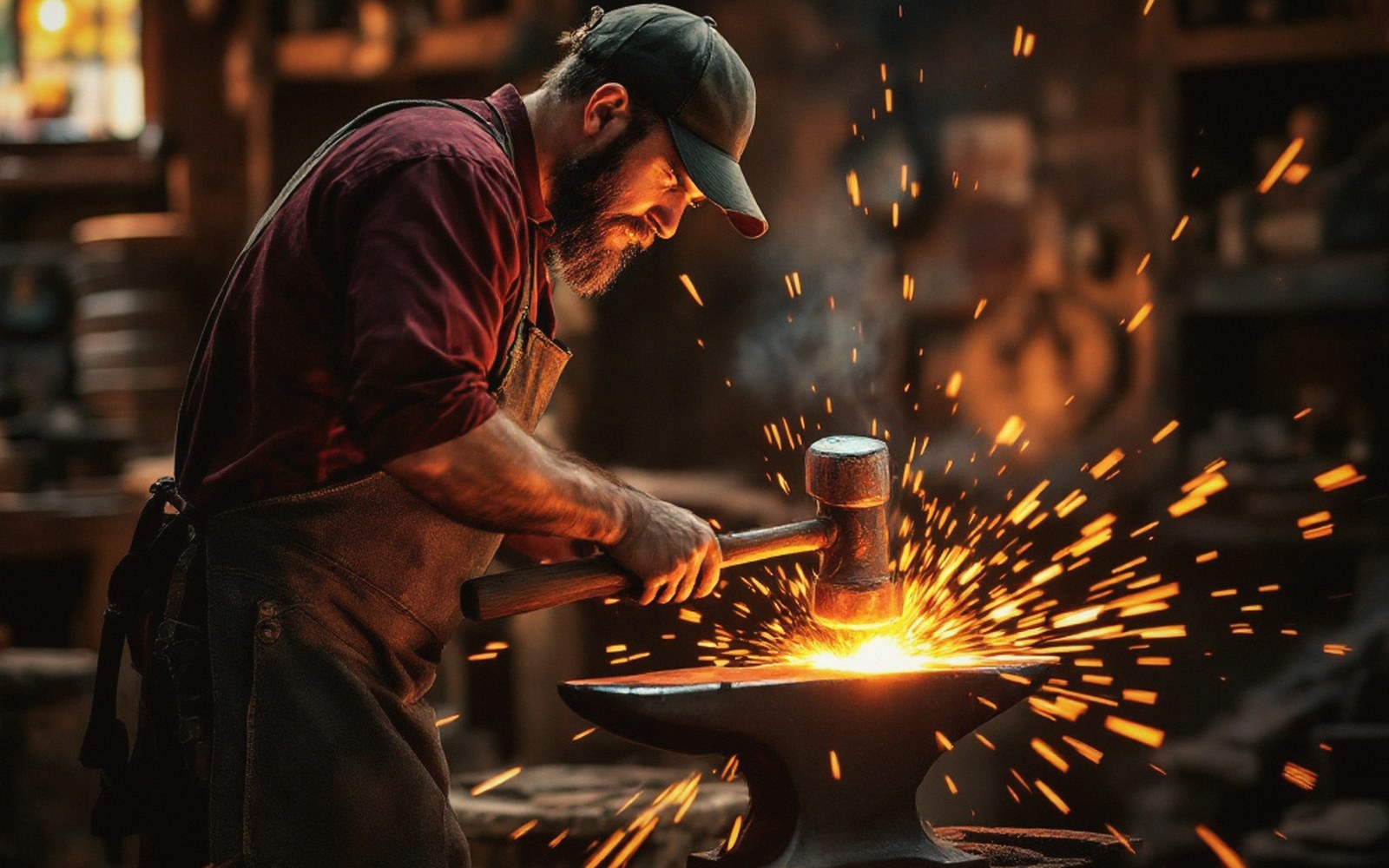
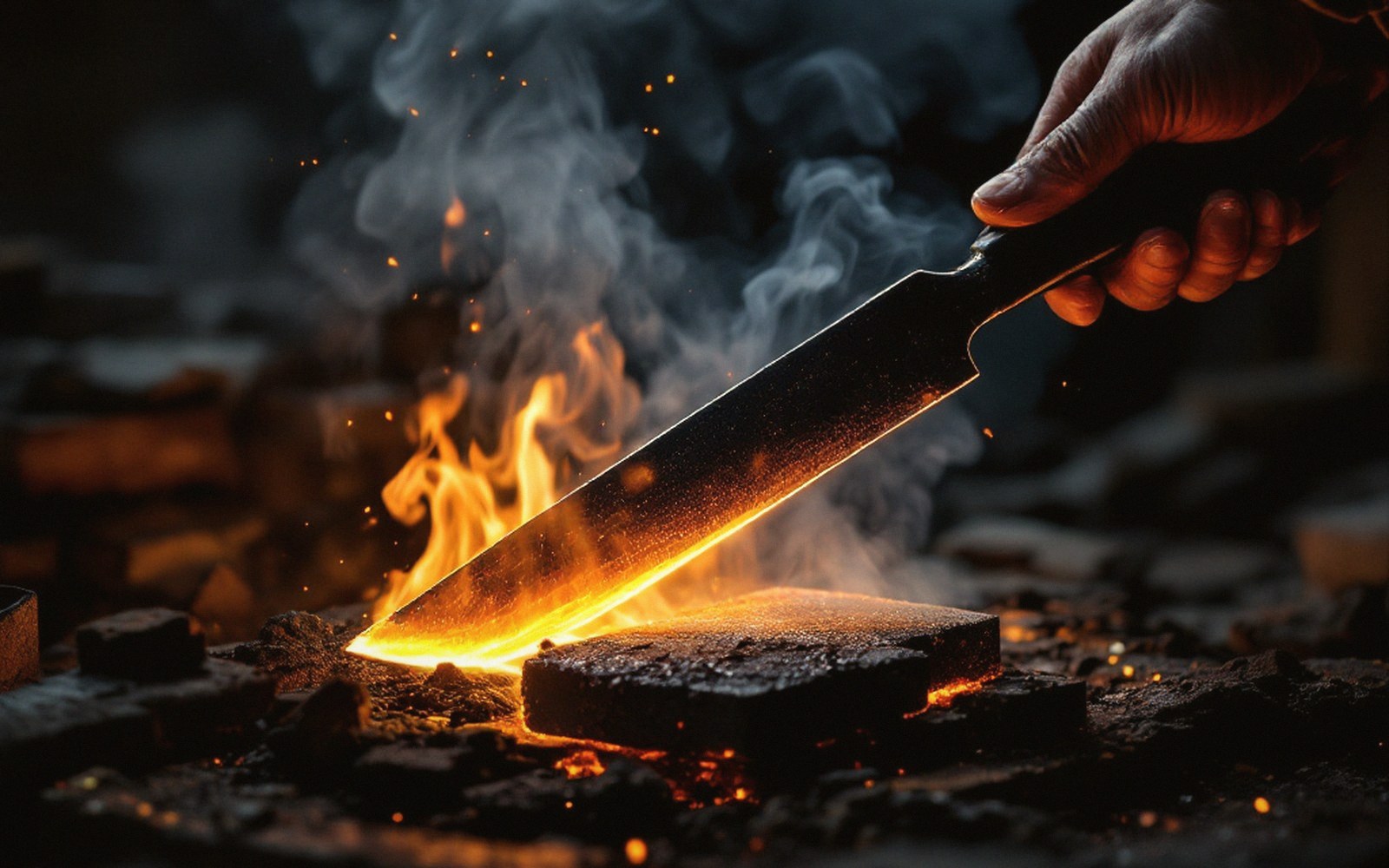
The crucible process — also called cast steel — was only the beginning of the chain. Once the ingots were rolled or hammered into bar, the Sheffield trades took over: the forger shaped the blank under a trip hammer or hand-worked it on an anvil, the hardener quenched the blade in a trough of water or oil to lock in hardness, and then the temperer reheated it to a precise colour — drawn straw, purple, blue — to give back enough toughness that the edge would not shatter under use. Hardening and tempering as a practice is ancient; what the crucible steel gave was a material consistent enough that those colour-to-temperature judgements became reliable and repeatable.
Then the grinder. Sheffield's grinding wheels ran in wheel-races along the rivers Don, Rivelin, Sheaf and Loxley, where water power was available long before steam. The work was hazardous: dry grinding produced fine steel dust that caused grinder's asthma, a respiratory disease well documented by the Sheffield physician Thomas Holland in the early nineteenth century and studied earlier by Arnold Knight in the 1820s. Wet grinding was safer and eventually standard, but the grinder's life expectancy remained sobering throughout the hand-trade era. The knife, scissors, saw, file or scythe that left Sheffield carried the consequence of that labour in its edge.
Key steps in the Sheffield edge chain
03 Steel · lifted out of the flow- Crucible meltingslag-free, homogeneous steel cast into ingots
- Forgingblank shaped by hammer, hand or mechanical trip
- Hardeningblade quenched in water or oil to achieve hardness
- Temperingcontrolled reheat to a colour-judged temperature to restore toughness
- Grindingwheel-dressed on water- or steam-powered stone to form and sharpen the edge
What the reputation built and what replaced it
By the mid-Victorian period Sheffield produced the majority of the world's high-quality edge tools, saw blades, springs and surgical instruments. The name on a blade — Sheffield-made, Sheffield steel — was a commercial signal that needed no elaboration. The city's metalworking firms clustered by specialism: the Lower Don Valley for heavy steel, Ecclesfield for files, Clarkehouse Road for surgical instruments. The trade mark, the pattern number, the maker's name were stamped not merely for pride but because forgery was common, and origin meant something concrete about material quality.
The crucible process was itself made redundant by the Bessemer converter and the Siemens open-hearth furnace in the second half of the nineteenth century, and later by the electric arc furnace, each capable of producing alloy steel in volumes the pot furnace could not approach. Sheffield adapted: alloy steels — stainless steel, patented in the city by Harry Brearley in 1913, and a range of high-speed tool steels — required the city's accumulated knowledge of heat treatment and working even as the underlying process changed utterly. What survived was less a method than a metallurgical literacy, a collective understanding, built across generations, of how steel behaves when you cut, quench and grind it.
That literacy is thinner now than it was, but it is not gone. Specialist cutlers still finish blades in the city. The hand forging of short runs — bespoke knives, specialist tools — survives where no automated process is economical. The Orb on a Harris Tweed labels provenance by statute; Sheffield's marks were never a statutory guarantee of origin in the way the Orb is, but they were enforced as trade marks, and the name did most of the work. The name has been the guarantee.