03 Steel Process 02
Hardening and Tempering
Quench for hardness, then reheat to give back enough toughness that it will not shatter.
The Hardening Stage
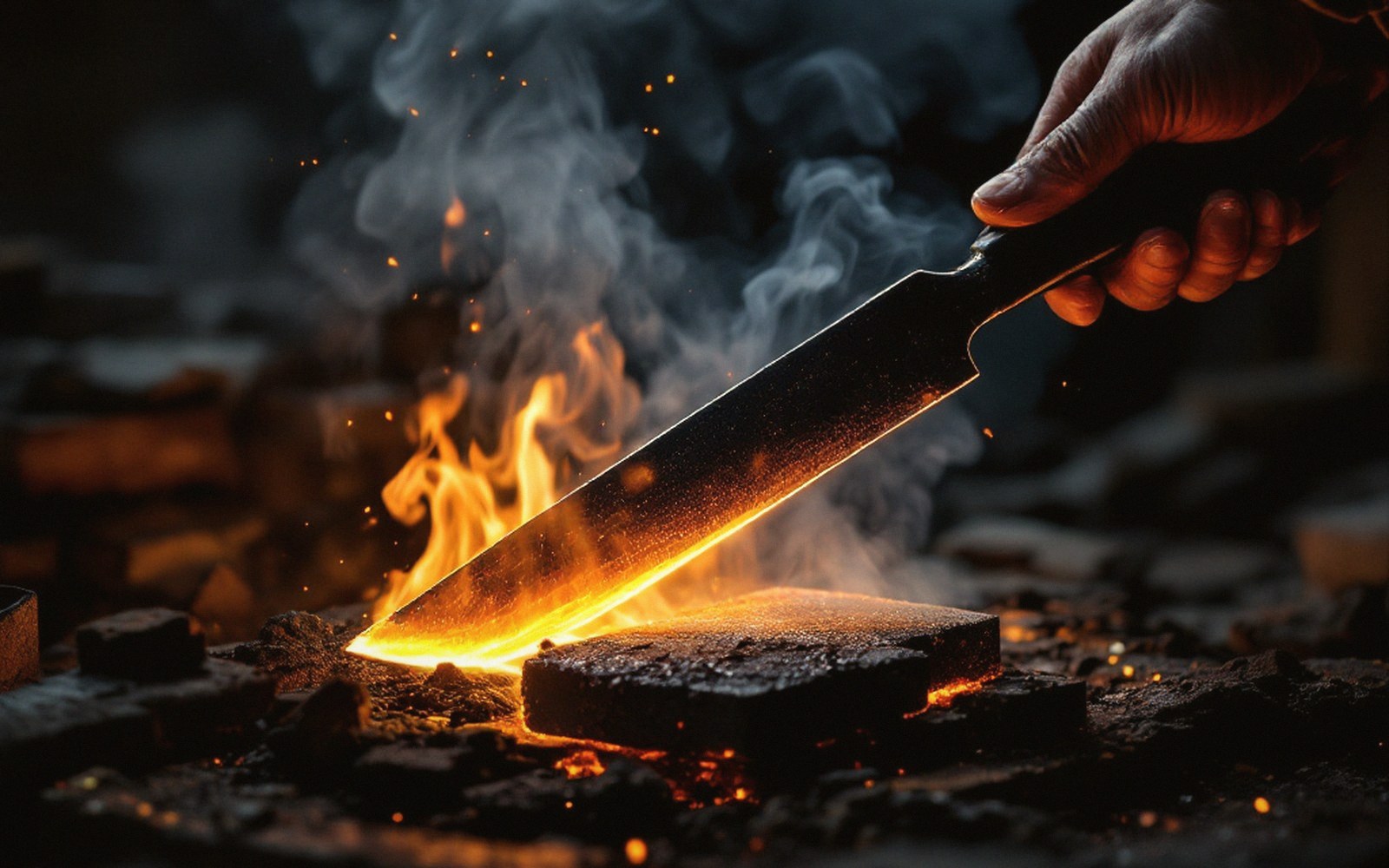
Steel in its soft state is a mix of iron and carbon arranged in relatively open crystal structures. Heat the metal to somewhere above 720 °C — the exact figure depends on carbon content and alloying elements — and the carbon dissolves evenly into the austenite phase, a face-centred cubic arrangement that is happy to hold it. Hold it there, and the structure homogenises. Then quench: plunge the steel into water, brine or oil, and the temperature drops so fast that the carbon has no time to migrate back out. Instead it is trapped inside a distorted, body-centred structure called martensite. That distortion is the hardness. It also happens to be extremely brittle.
The choice of quench medium is not trivial. Water is severe — it cools fast, which maximises hardness, but the shock can crack or warp the work. Oil is slower, kinder to complex sections; brine is faster than plain water and suits tool steels that need deep hardening. In Sheffield edge work, the quench medium and its temperature were closely guarded knowledge, as significant as the alloy itself. Polymer quenchants are now used where precise, repeatable cooling rates matter, adjusting concentration to dial in the result. The geometry of the part matters too: thick sections cool more slowly at the centre, so the surface may be fully martensitic while the core remains softer — a condition with its own uses in springs and axles, where a hard exterior over a tough interior is exactly what you want.

The Tempering Stage
As-quenched steel is too brittle to use for most purposes. A chisel or a cutting die that cannot absorb a shock is a liability. Tempering is the remedy: the work is reheated to a controlled temperature, held there, then allowed to cool. The heat gives the trapped carbon just enough mobility to precipitate out as tiny iron carbide particles, relieving the worst of the lattice distortion and with it the worst of the brittleness. Hardness falls; toughness rises. The art is in knowing how far to go.
Tempering temperatures range roughly from 150 °C for a razor — where you want the maximum retained hardness — up to around 650 °C for a spring, where toughness dominates. In between, different tools land at different points: scalpel blades and files at the low end, woodworking chisels and knives in the middle band, torsion bars and heavy press tools higher up. A modern thermostatically controlled oven makes this repeatable to within a few degrees. Before that, smiths used oxidation colours: polished steel changes from pale straw at around 220 °C through gold, then purple, then blue at around 300 °C. A skilled eye on a flat polished face could read the advancing colour front and quench again at the right moment. The colour is a surface effect — an oxide layer, not a structural change — but as a proxy for temperature it is reliable enough that it is still used today for small-batch and hand-finished work.
Key temperatures and what they mean
03 Steel · lifted out of the flow| ~720 °C and above | austenite range; carbon dissolves into the structure |
| Water quench | maximum hardness, maximum risk of cracking |
| Oil quench | slower cooling; suits complex or alloy steel sections |
| 150–200 °C temper | maximum retained hardness; razor blades, fine cutting tools |
| 220 °C (straw oxide colour) | light temper; turning tools |
| ~300 °C (blue oxide colour) | higher toughness; springs, screwdrivers |
| 600–650 °C temper | maximum toughness recovery; heavy springs, torsion bars |
For large, complex components — press tools, die-cast moulds, aerospace parts — tempering typically runs in two separate cycles. Double tempering ensures that any retained austenite (martensite's less-transformed sibling, which may survive the first quench) is itself transformed and then tempered. Skip this, and retained austenite may convert during service, bringing a small volume change that distorts a precision component.
The sequence — austenitise, quench, temper — is simple in principle, governed by physics that does not change. What changes is the precision with which each stage is controlled, and the depth of knowledge about how a particular alloy responds. That knowledge, accumulated in workshops across Sheffield and the wider steel-manufacturing belt over two centuries, is why certain specifications still name British sources. Heat treatment looks like craft. It is, in fact, a silent transformation: controlled change of material at the atomic scale.
Heat the steel to critical temperature, quench it to lock in hardness, then reheat it carefully to restore the toughness you just destroyed.