06 Glass Process 01
Lead Crystal
Lead oxide softens the melt and raises the refractive index, which is why cut crystal flashes.
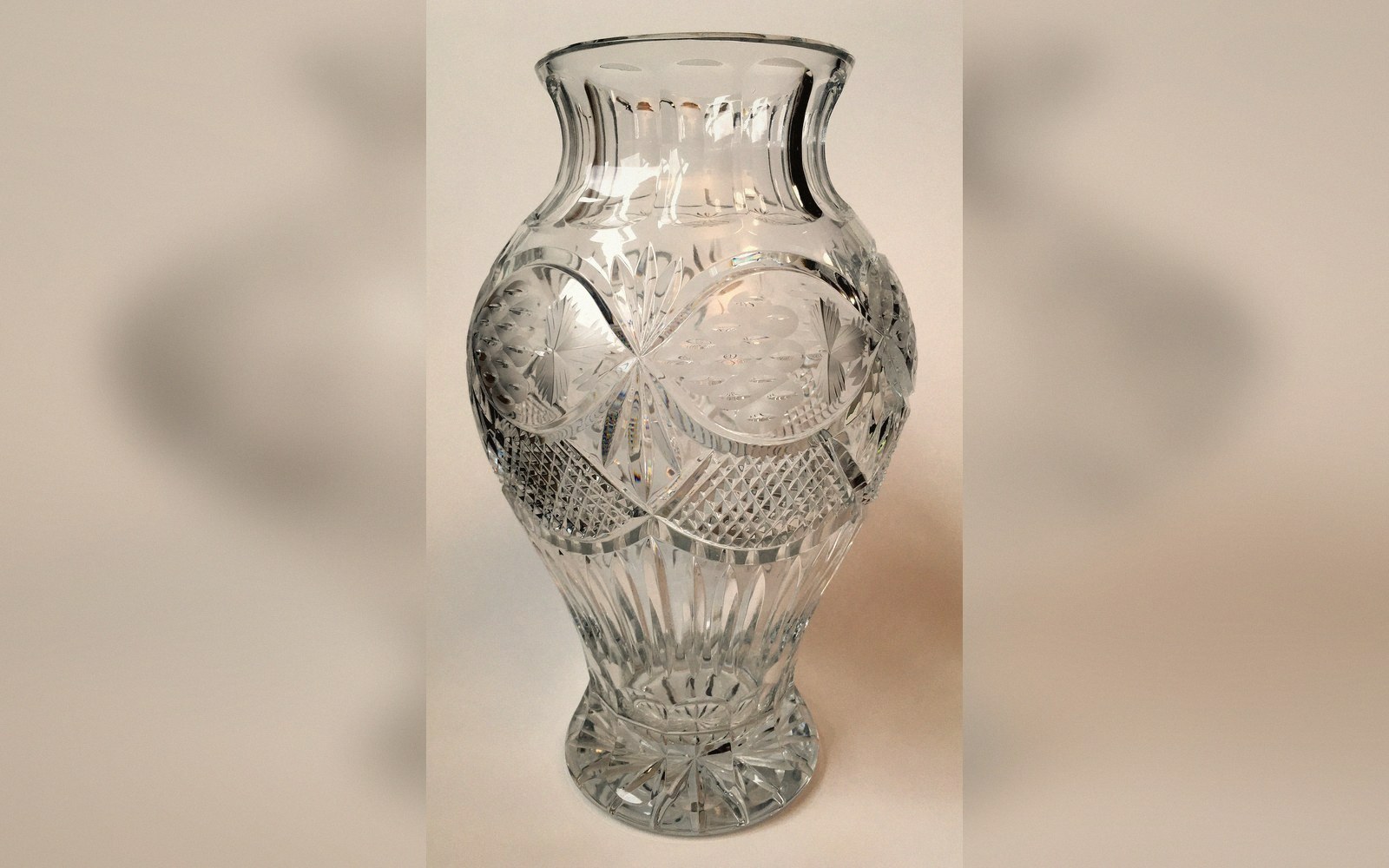
The oxide that makes glass ring and flash
Lead oxide added to a silica melt does two things at once: it lowers the temperature at which the glass becomes workable, and it raises the refractive index — the degree to which the material bends light. Both effects matter. The first gives a glassworker more time to shape the piece before it stiffens; the second means that when a cutter grinds facets into the surface, each one catches and splits the light with the kind of brilliance that plain soda-lime glass simply cannot match.
Traditional full lead crystal contains at least 24 per cent lead oxide by weight — the threshold set by EU directive 69/493/EEC ↗, which the UK carried into its own standards. At 30 per cent or above, used by some prestige makers, the glass acquires a noticeable density; lift a full lead crystal decanter and you feel it. The characteristic ring — a long, sustained note when the rim is tapped — comes from the same composition: lead silicate transmits vibration more cleanly than a glass heavy with other modifiers.
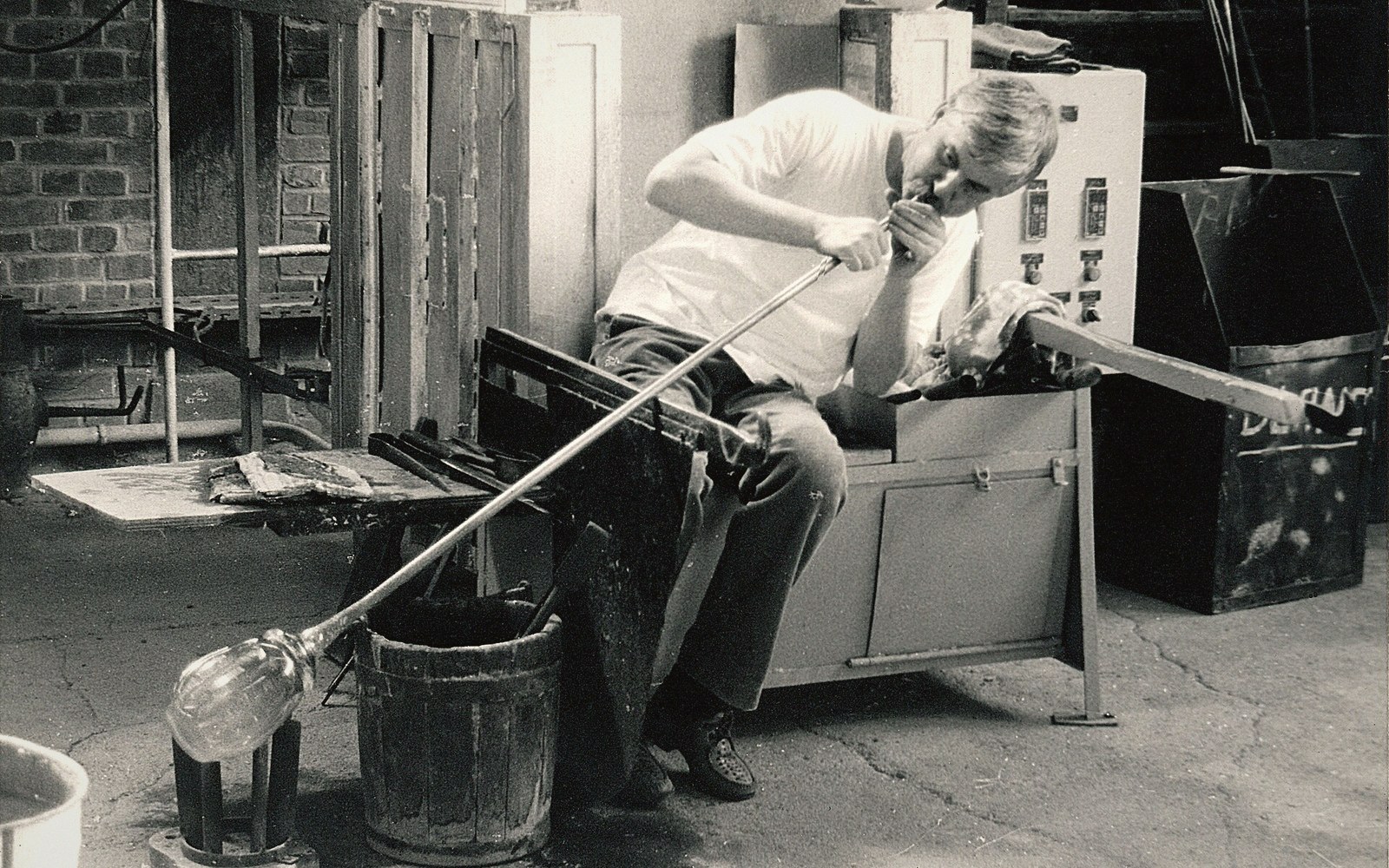
Melting, blowing, cutting
The raw batch — silica sand, potassium carbonate, red lead (lead oxide, Pb₃O₄), and a small amount of decolouriser, traditionally arsenic or manganese — is melted in clay pots inside a furnace running between 1,200 and 1,400 °C. Pot furnaces rather than continuous tanks are traditional for crystal: smaller batches, more control, and no contamination between colours or compositions. The glass is gathered on the end of a blowpipe, marvered on a flat iron plate to centre it, then blown and shaped with a combination of breath, a wooden block soaked in water, and shears. Hand blowing of this kind requires the gather to be kept moving — the moment the piece stops rotating, gravity wins.
After blowing, the piece goes straight into the annealing oven. Crystal's high lead content makes it more susceptible to thermal shock than ordinary glass, so the temperature drop must be very gradual — several hours in a lehr, the long tunnel kiln that controls the cooling curve precisely. A piece pulled from the furnace and allowed to cool in open air would carry internal stresses that could fracture it days or weeks later, apparently without cause. Annealing is not optional.
Cutting is a separate trade. The blank arrives at the cutting shop already annealed, and a marker lays out the pattern — traditionally in wax crayon against a paper template slid inside the piece. Cutting wheels are cast iron fed with an abrasive slurry, or nowadays diamond-coated wheels running wet. Each facet is ground in stages: a roughing cut first, then progressively finer wheels, then polishing, either on a wooden wheel with pumice and cerium oxide or by a brief dip in a bath of hydrofluoric and sulphuric acid, which etches the surface optically flat. The acid-polish method is faster; hand-polishing leaves surfaces fractionally more brilliant because each facet is worked individually.
Stourbridge and the British tradition
The British industry built itself around Stourbridge in the West Midlands, where local fireclay for crucibles, coal for the furnaces, and — crucially — a community of Lorraine glassmakers who arrived in the late sixteenth century established the technical foundations. By the eighteenth century, British lead crystal had become a distinct product: heavier, more refractive and better suited to deep cutting than anything made on the Continent.
The Worshipful Company of Glass Sellers ↗ had pressed for better English glass as early as the 1670s, and it was George Ravenscroft's experiments at the Savoy glasshouse in London — patented in 1674 — that first produced a stable lead glass suitable for blown and cut ware. Ravenscroft's formulation initially suffered from crizzling, a network of internal cracks caused by imbalances in the batch; the addition of more lead oxide stabilised it. The material that resulted became the template for almost every cut-glass tradition in Britain and Ireland that followed.
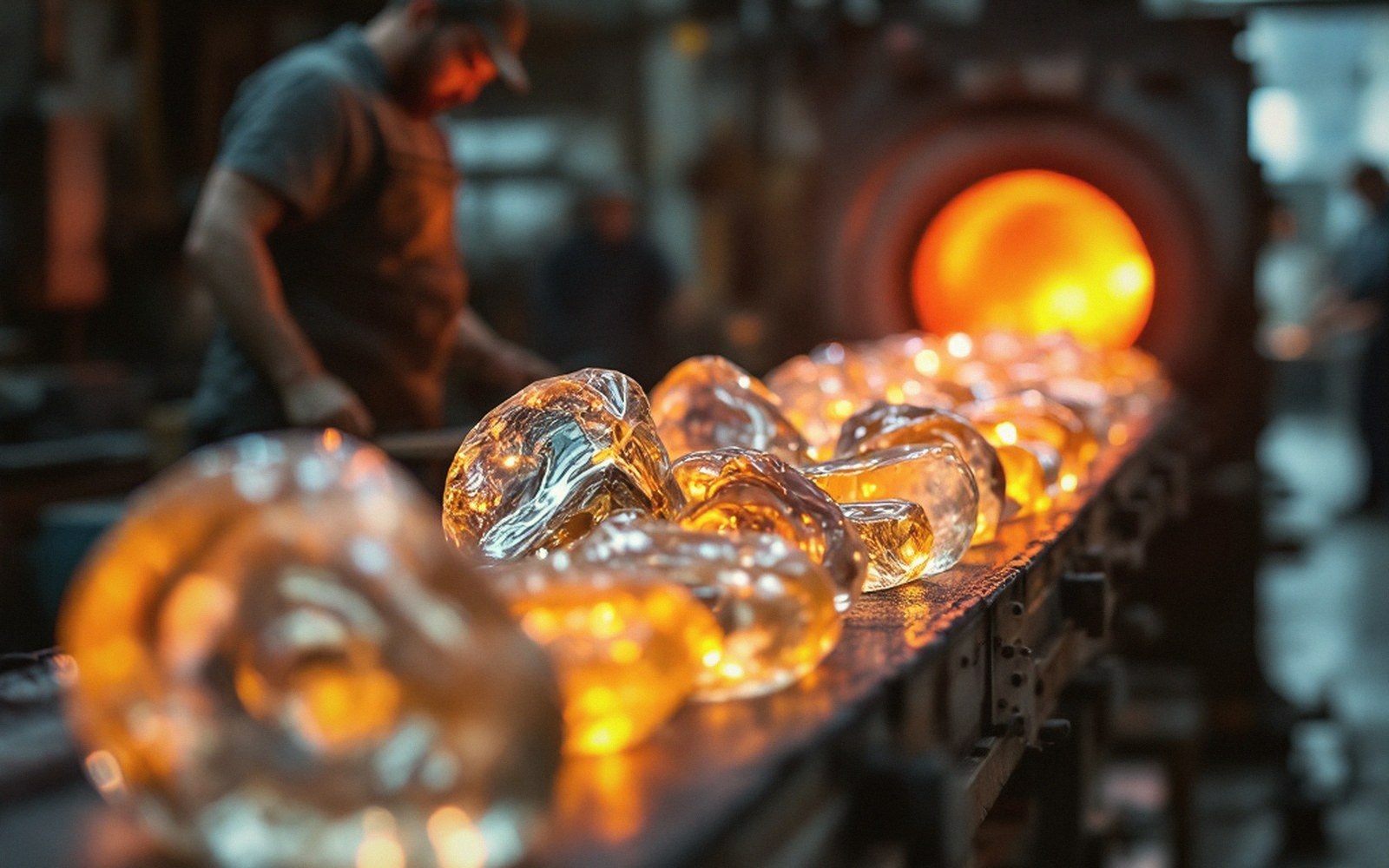
Contemporary production at Stourbridge continues at smaller scale, with hand-cut pieces still leaving workshops in the town. The lead content and the cutting standards have not changed; what has changed is how few hands now do the work.