06 Glass Process 03
Annealing
Cooling too fast leaves stress that will break the piece later, so it goes into a lehr for hours.
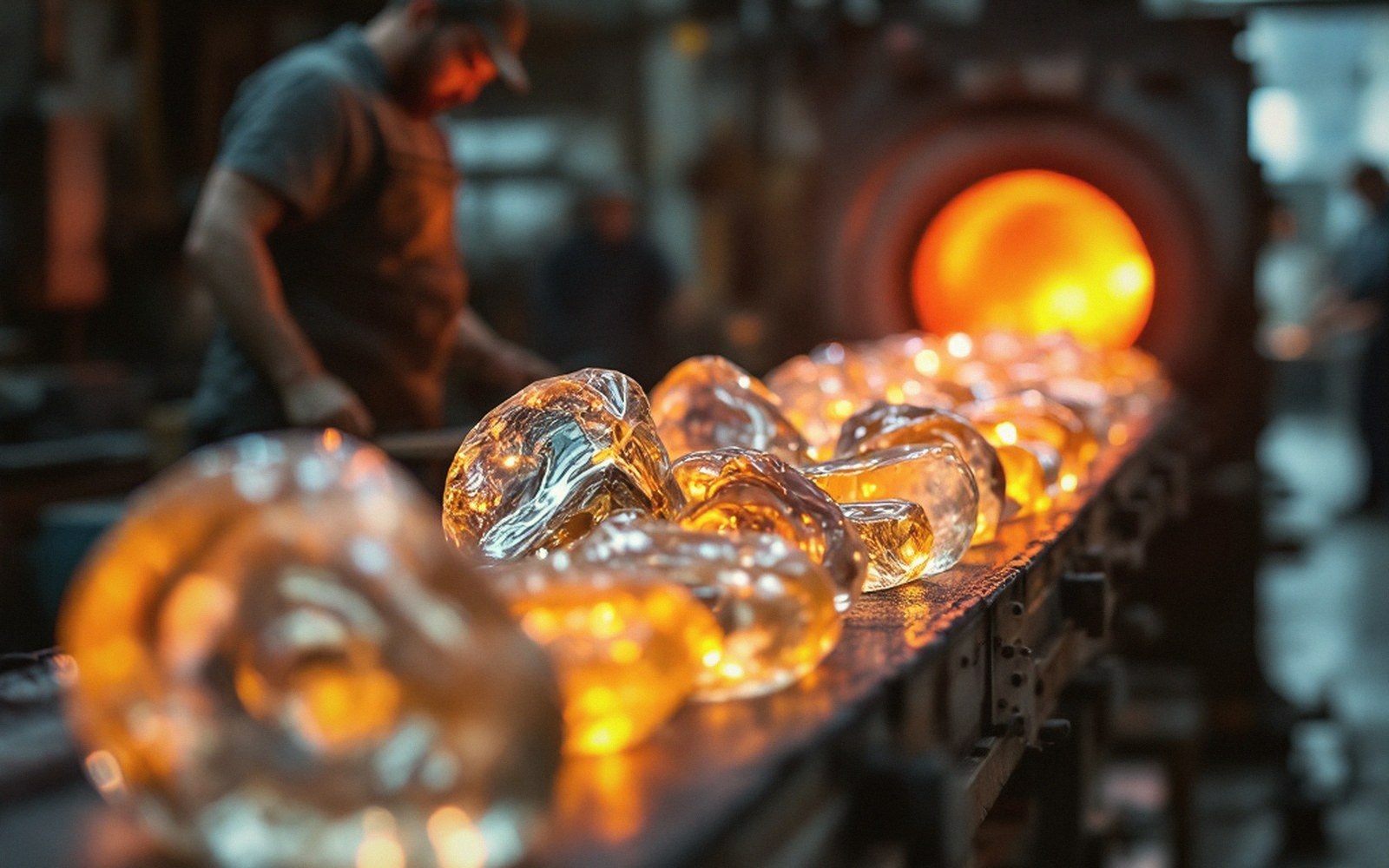
Into the Lehr
Glass that cools too fast breaks. Not always immediately — sometimes weeks or months later, from a shock no heavier than being lifted from a shelf. The reason is internal stress: if the outside surface sets before the core has contracted, the two layers are fighting each other in every finished piece. The crack, when it comes, is following a fault that was built in the moment the glass left the heat.
The solution is the lehr (the word's origin is uncertain, but it is standard in English glassmaking). A lehr is a long, tunnel-like oven, kept at a precise temperature band and cooled very gradually along its length. Finished pieces enter at the hot end and ride a slow-moving belt toward the cool end. A typical annealing cycle runs anywhere from a couple of hours for thin pressed ware to eighteen hours or more for heavy optical blanks or hand-blown vessels of substantial weight.
The target entry temperature sits near the glass's annealing point — roughly the temperature at which the material is viscous enough for internal stresses to relax but rigid enough to hold its shape. For soda-lime glass, the standard material for containers and windows, that point falls around 550 °C. For lead crystal, which has a different composition and different thermal properties, the curve shifts and the schedule is recalculated accordingly. Borosilicate glass — the kind used in laboratory ware and oven dishes — has a low coefficient of thermal expansion and is more tolerant, but it still goes through the lehr.
The rate of cooling through the strain point is the critical variable. Above the strain point, glass behaves like a very stiff liquid: stresses can still flow out and equalise. Below it, they are locked in. Cool through that narrow band too quickly and the frozen-in tension is enough to make a piece that rings, holds liquid and looks perfect — but is brittle in ways the eye cannot detect.
Key temperatures
06 Glass · lifted out of the flow| Annealing point (soda-lime glass) | approx. 550 °C; the temperature at which internal stresses begin to equalise |
| Strain point | slightly below the annealing point; the temperature below which stresses are permanently locked in |
| Typical lehr cycle | a few hours for thin ware; up to 18 hours or more for heavy or optical pieces |
At the Pilkington glass plant in St Helens, float glass ribbon travels continuously through an annealing lehr as part of the production line, the temperature gradient carefully managed over dozens of metres. At smaller studios, the lehr is the quietest machine in the workshop: no drama, no noise, just time and heat doing the structural work that the fire alone cannot.
A piece that has been annealed properly is stable. It will still break if you drop it. But it will not betray you.
The most dangerous moment in glassmaking isn't the furnace — it's what comes after.